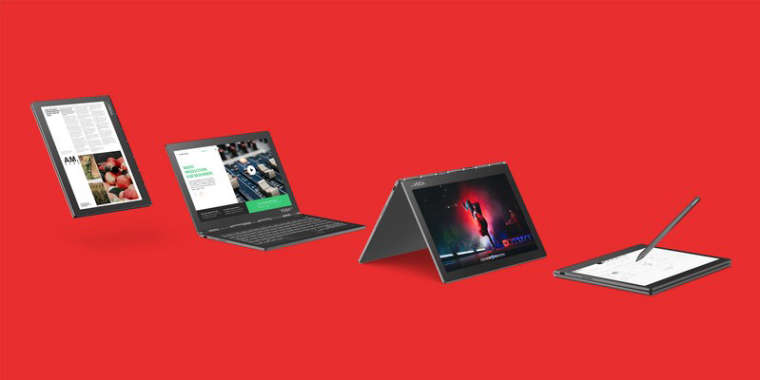
Lenovo launched the world's first laptop with two screens Thursday as it looked to continue momentum from a recent rebound in PC sales.
The Yoga Book C930 is a 999 euro ($1,164) Windows device with the following features:
-
Two screens with a digital keyboard,
-
One screen that turns into an e-reader,
-
A bluetooth pen to write on the screen.
In refining what the Yoga Book is, and who is should be for, Lenovo has narrowed its potential customer set down to those who have enough disposable income to afford a Yoga Book as a secondary computer, or as a travel device. It’s hard to fathom millions of people buying this. At the same time, Lenovo—which has managed to expand its image beyond that of a strictly-enterprise laptop maker over the past several years—deserves credit for experimenting once again.
Lenovo says the Windows version of the 2016 Yoga Book sold much better than the Android version did; as a result, this new Yoga Book (with the forgettable name C930) will ship only as a Windows 10 device. In some ways this means it’s really more of a laptop than a tablet. It ships with a 7th generation Intel Core i5 or Core M processor—not the latest, but an upgrade from the Atom processor in the 2016 Yoga Book. It has four gigabytes of memory, and 258 gigabytes of SSD storage. There’s also the option for LTE, which will come in handy for those frequent travelers Lenovo is targeting.
The device will be available from the end of September in Europe, the Middle East and Asia.
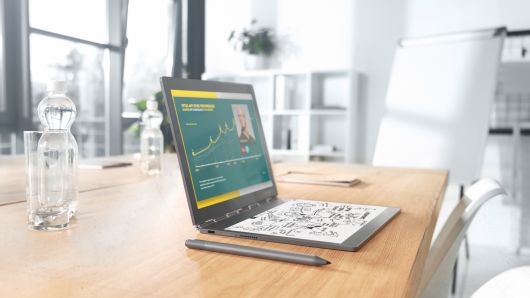
Its dimensions are almost the exact same as the last Yoga Book. This one weighs 1.7 pounds; the first model weighed 1.5 pounds. The top display on the new one is slightly larger: a 10.8-inch, quad HD, touchscreen display, compared with the earlier 10.1-inch display.
It’s the “keyboard” part of the laptop that’s changed the most. It was a digitizer before; now it’s basically a second display. And it’s an E-Ink display, replacing the “Halo” keyboard from the previous generation. Users can choose between a couple different E-Ink keyboard styles to start, and control the ink color and contrast in settings.
The inclusion of E-ink also means you can fold it over and use it as a reading device. When it first ships, though, it will only support a PDF reader and not apps like Kindle. You can use a Wacom stylus on both top and bottom displays, switching to a Lenovo-made note-taking app on the bottom. In pre-briefings, Lenovo described a use case in which you can write a note on the bottom half, select it and transform it into text, and then drag to copy it into a Word document on the upper display.
It’s still a zero-travel keyboard, meaning it’s totally flat, but Lenovo says the sensory feedback has been improved both in terms of vibration and sound. This haptic feedback is meant to give you a sense of keys bouncing off your fingertips, even when you’re just plunking them on a flat surface. Each individual key is also a little larger. The biggest adjustment might be on the AI side: Lenovo says it’s storing learning patterns for how users type on the device. This isn’t to offer predictive typing, the company says, but more about offering accurate typing. If you tend to hit your “J” key a little high, for example, the keyboard will “know” that that’s the key you mean to hit.
Another new feature: the Yoga Book C930 includes a “knock to open” feature. Because of the laptop’s chiseled edges, it might be hard to wedge a fingertip in its front lips to get the thing open, even though there is a slight indent there. So the laptop’s accelerometer detects when you double-knock on the top of the laptop, and sends a current to a shape-shifting alloy that contracts, pushes some magnets around, and pops open the laptop. It also goes into “bag mode,” so it doesn’t accidentally open in your bag, when the laptop is placed at a certain orientation and motion is detected.
Lenovo has looked to diversify revenues away from its core PC business with investments in so-called internet of things (IOT) technology. This term refers to internet-connected devices.
At the IFA consumer electronics show in Berlin, Germany, Lenovo unveiled a series of smart home products including an internet-connected plug, camera and light bulb. These will be compatible with Amazon Alexa and Google Assistant products with availability in the U.S. starting in November.